Back to Research Library
7 Studies

Meniscus Cartilage

The meniscus plays a crucial role in joint stability and lubrication, capable of withstanding over two million steps per year. Our research has challenged conventional contraindications for meniscus replacement in arthritic knees.

300+
Total Patients Studied
89.4%
Allograft Survival
5.8 Years
Mean Follow-up
48 Years
Mean Age at Surgery

About This Research Area

The meniscus is a soft, fibrous cartilage resting between the femur and tibia. A healthy meniscus provides a gliding surface in the knee that is five times smoother than ice on ice. When damaged, the knee transmits force abnormally, leading to arthritis and pain.

Meniscal transplantation was previously indicated only for patients with mild arthritis, under 50 years of age. Our research demonstrates that meniscus allografts can successfully survive in arthritic knees, expanding treatment options for patients who would otherwise face joint replacement.

Current Research Projects

Active studies investigating new approaches to meniscus regeneration and transplantation.

Patient Stories

See how meniscus transplantation has helped patients avoid joint replacement.

View Patient Stories

Education

Educational resources about meniscus repair and transplantation techniques.

Explore Education Programs

Published Studies

Showing 7 of 7 studies

Meniscus Cartilage Knee 2024

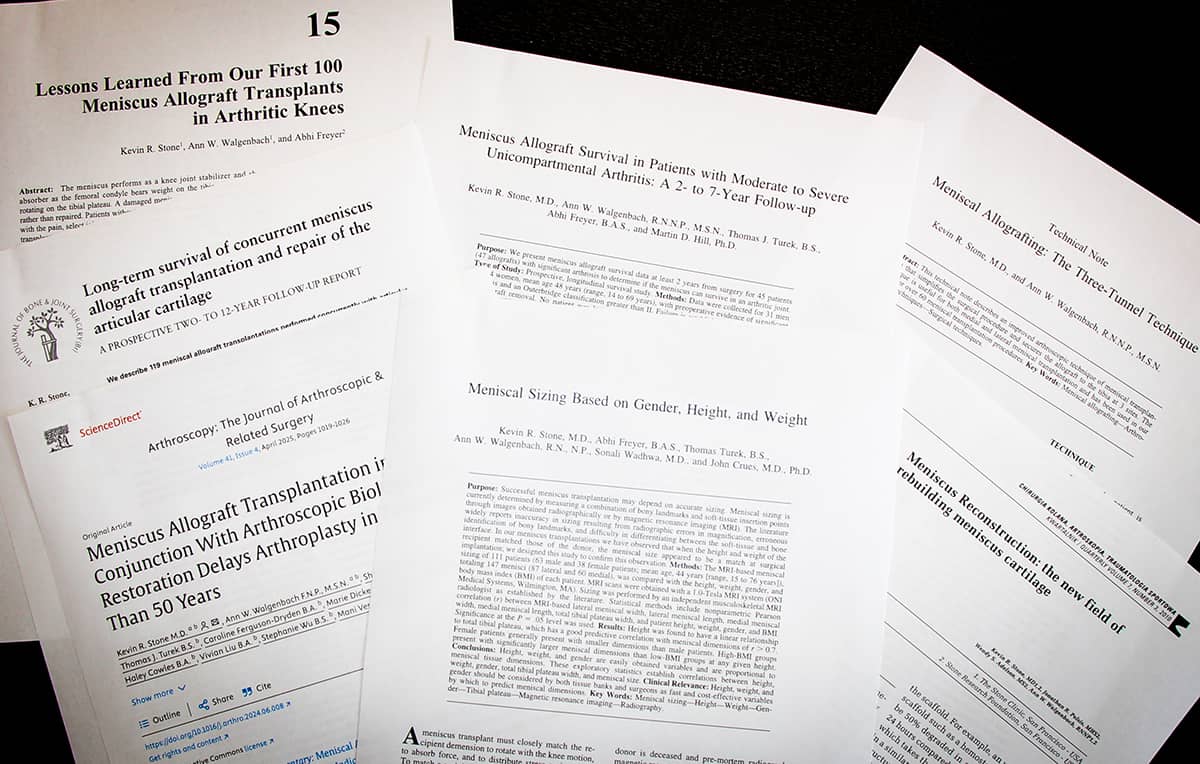
Meniscus Allograft Transplantation in Conjunction with Biologic Knee Restoration Delays Arthroplasty in Patients Older Than 50 Years

Kevin R. Stone, Ann W. Walgenbach, Shadera Slatter, Thomas J. Turek, Caroline Ferguson-Dryden, Marie Dicker, Emma Miltenberger, Haley Cowles, Vivian Liu, Stephanie Wu, Mani Vessal

Meniscus allograft transplantation in conjunction with biologic knee restoration procedures can effectively delay or prevent the need for total knee arthroplasty in patients older than 50 years.

Key Finding: Meniscus allograft transplantation with biologic knee restoration delays arthroplasty in patients over 50 years old.

Arthroscopy View Publication
Meniscus Cartilage Knee 2010

Long-term Survival of Concurrent Meniscus Allograft Transplantation and Articular Cartilage Repair

Kevin R. Stone, Wendy S. Adelson, Johnathan R. Pelsis, Ann W. Walgenbach, Thomas J. Turek

Combined meniscus allograft transplantation with articular cartilage repair procedures demonstrates excellent long-term survival and functional outcomes.

Key Finding: Concurrent meniscus allograft transplantation and articular cartilage repair provides long-term joint preservation.

Journal of Bone and Joint Surgery (British) View Publication
Meniscus Cartilage Knee 2010

Meniscus Reconstruction: The New Field of Rebuilding Meniscus Cartilage

Kevin R. Stone, Johnathan R. Pelsis, Wendy S. Adelson, Ann W. Walgenbach

Meniscus reconstruction techniques offer new possibilities for rebuilding meniscus cartilage in patients who have lost this critical structure.

Key Finding: Meniscus reconstruction represents a new paradigm for rebuilding damaged meniscus cartilage.

Knee Surgery, Arthroscopy, Sport Traumatology View Publication
Meniscus Cartilage Knee 2008

Lessons Learned From Our First 100 Meniscus Allograft Transplants in Arthritic Knees

Kevin R. Stone, Ann W. Walgenbach, Abhi Freyer

Meniscus transplantation is a rewarding soft tissue reconstruction that can be useful for arthritic as well as pristine knees to alleviate pain, restore function, and ultimately, delay or avoid joint arthroplasty.

Key Finding: Comprehensive review demonstrating allografts can survive in arthritic knees and delay joint replacement.

Humana Press - Musculoskeletal Tissue Regeneration View Publication
Meniscus Cartilage Knee 2007

Meniscal Sizing Based on Gender, Height, and Weight

Kevin R. Stone, Abhi Freyer, Thomas J. Turek, Ann W. Walgenbach, Sonali Wadhwa, John V. Crues III

Height, weight, and gender should be considered by both tissue banks and surgeons as fast and cost-effective variables by which to predict meniscal dimensions.

Key Finding: Height, weight, and gender correlate with meniscal dimensions—simplifying tissue bank matching protocols.

Arthroscopy View Publication
Meniscus Cartilage Knee 2006

Meniscus Allograft Survival in Patients with Moderate to Severe Unicompartmental Arthritis: A 2- to 7-Year Follow-up

Kevin R. Stone, Ann W. Walgenbach, Thomas J. Turek, Abhi Freyer, Martin D. Hill

Meniscus allografts can survive in a joint with arthrosis, challenging the contraindications of age and arthrosis severity. These results compare favorably with those in previous reports of meniscus allograft survival in patients without arthrosis.

Key Finding: 89.4% allograft survival rate in arthritic knees—challenging conventional contraindications of age and arthrosis.

Arthroscopy View Publication
Meniscus Cartilage Knee 2003

Meniscal Allografting: The Three-Tunnel Technique

Kevin R. Stone, Ann W. Walgenbach

An improved arthroscopic technique of meniscal transplantation that simplifies the surgical procedure and secures the allograft to the tibia at 3 sites. The technique is useful for both medial and lateral meniscal transplantation.

Key Finding: Improved arthroscopic technique securing allograft to tibia at 3 sites for better stability.

Arthroscopy View Publication

Clinical Significance

Our research has fundamentally challenged the conventional contraindications for meniscus allograft transplantation. Prior to this work, patients over 50 or those with significant arthrosis were typically excluded from consideration.

The 89.4% survival rate in arthritic knees—with 25% of patients over age 55—demonstrates that biologic joint reconstruction can be a viable alternative to arthroplasty for motivated patients seeking to maintain active lifestyles.

The sizing study has practical implications for tissue banks worldwide, establishing that simple anthropometric measurements (height, weight, gender) can predict meniscal dimensions, streamlining the donor-recipient matching process.

Educational Videos

Educational

Torn Meniscus Cartilage Overview

The knee joint is composed of two types of cartilage: articular cartilage and meniscus cartilage. Repair of the meniscus is extremely important for joint stability, force transmission, lubricity, and protection of the articular cartilage. When the meniscus is lost, the joint space becomes abnormal as articular cartilage wears down.

Surgical Technique

Meniscus Transplantation: Three-Tunnel Technique

The meniscus cartilage can be replaced by an outpatient arthroscopic procedure. Through small portals, we create tunnels where the meniscus inserts on the front, back, and corner of the knee, then pull the donor meniscus through with sutures and secure it around the rim.

"Meniscus transplantation has completely changed our perception of knee arthritis and how to treat it. In the past when a person would get arthritis, there would be wearing away of the articular cartilage. Very commonly that occurs when an athlete has torn their meniscus and a surgeon removed part of it. Over the years, the patient wears away the articular cartilage. Now we can replace that meniscus and prevent the progression to severe arthritis."

— Dr. Kevin R. Stone