Back to Research
5 Studies

Articular Cartilage

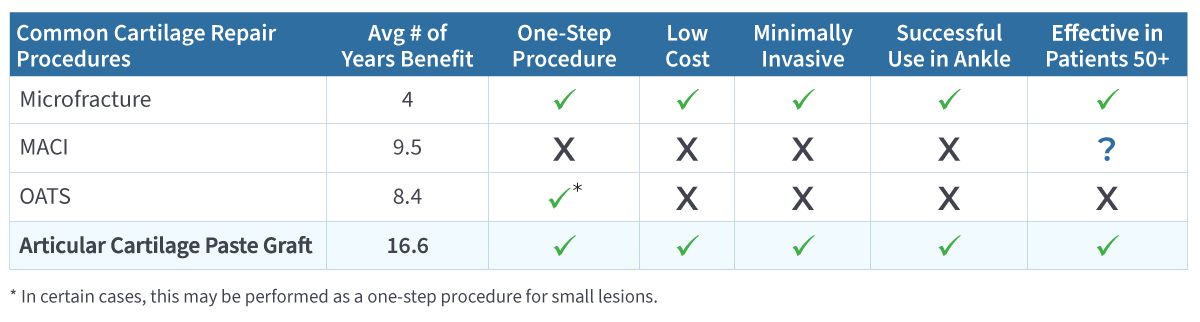
Articular cartilage covers the bones in joints and contributes to smooth, pain-free motion. Our research focuses on the paste graft technique—a single-stage, minimally invasive procedure for restoring damaged cartilage surfaces.

275+

Total Patients Studied

23 Years

Longest Follow-up

19.1 Years

Median Benefit Time

85.6%

Success Rate

About This Research Area

Damaged articular cartilage has a limited ability to heal on its own. Damage can lead to pain, swelling, and loss of motion. The articular cartilage paste graft was developed in 1991 by Dr. Kevin R. Stone as a cost-effective, minimally invasive technique for cartilage repair indicated for both widespread and focal cartilage damage.

The technique uses autologous cartilage and bone harvested from the intercondylar notch, morselized into a paste, and impacted into the prepared defect. Unlike other techniques, paste grafting is entirely arthroscopic, uses autologous tissue, and is performed in a single session.

Clinical Significance

Our long-term outcome data demonstrates that paste grafting provides durable pain relief and functional improvement for patients with severe cartilage damage—a population often told their only option is joint replacement.

The 2016 study showing a median benefit time of 19.1 years represents one of the longest follow-ups in cartilage repair literature. For patients who ultimately required arthroplasty, the procedure successfully delayed it to a mean age of 60.2 years—when joint replacement outcomes are typically most favorable.

The 2020 basic science study provided mechanistic insight: contrary to the long-held belief that impaction trauma kills chondrocytes, morselization actually stimulates cell proliferation and matrix production, supporting the clinical observations of cartilage regeneration.

Veterinary Applications

Our articular cartilage research extends to veterinary medicine, helping animals recover from joint injuries using similar regenerative techniques.

For Veterinary Clinics

Find out why you should implement ArtCart+ in your clinic.

Find Out Now

For Equine Owners

Find out how ArtCart+ can improve the quality of your equine patient's life.

Find Out Now

Current Research Projects

Active studies investigating new approaches to cartilage regeneration and paste graft optimization.

Patient Stories

Real patients share their journey through treatment and recovery.

BioKnee

BioKnee Program: Endurance Athlete

48-year-old endurance athlete discusses multiple meniscus surgeries and biologic knee replacement.

Joint Replacement

Robot-Assisted Partial Knee Replacement

Alaska ski instructor John Lyman discusses his experience with Mako robotic surgery.

Educational Videos

Surgical Technique

Articular Cartilage Paste Graft

Surgical demonstration of paste grafting for a medial femoral condyle lesion.

View Full Details
Surgical Technique

Robot-Assisted Partial Knee Replacement

Mako orthopedic technologies soft tissue, robotic-assisted partial knee replacement.

View Full Details

Dr. Kevin R. Stone

When the joint becomes arthritic, the articular cartilage wears down to the surface of the bone. We make small holes to release marrow cells, then take articular cartilage and underlying bone from where it's not needed, smash it into a paste containing marrow stem cells, and pack it back onto the articular surface. This articular cartilage paste grafting, especially when combined with a meniscus replacement, provides what we call a biologic joint replacement rather than an artificial joint replacement.

Published Studies

Showing 5 of 5 studies

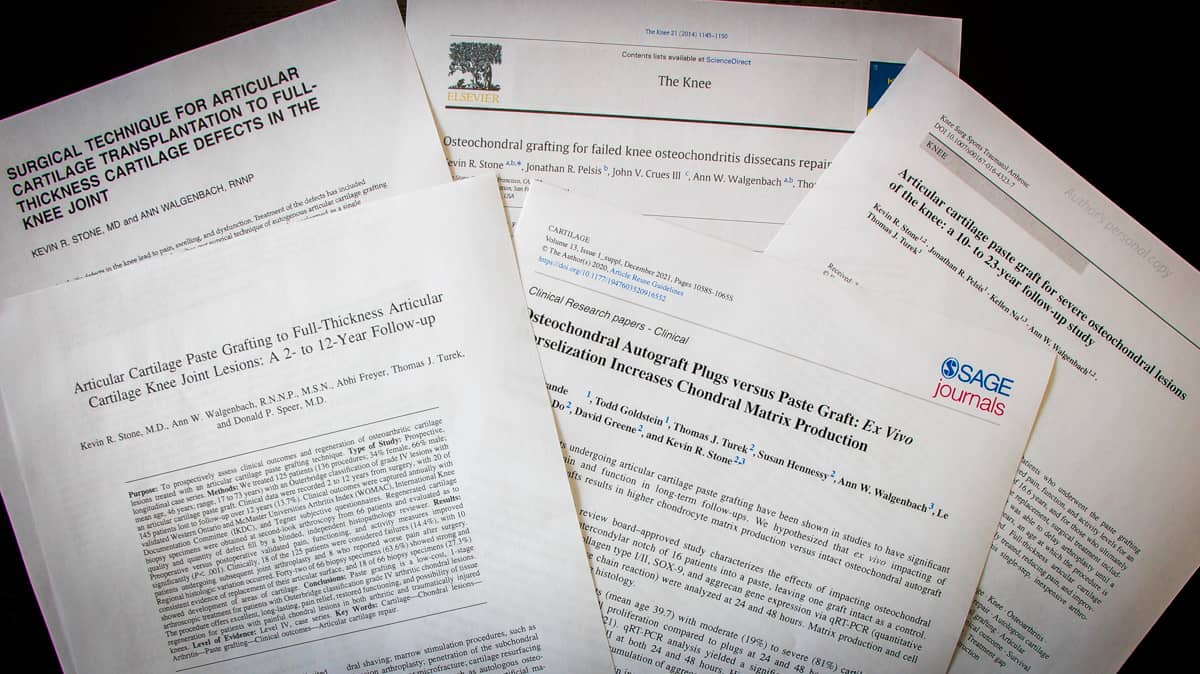
Articular Cartilage Knee 1997

Surgical Technique for Articular Cartilage Transplantation to Full-Thickness Cartilage Defects in the Knee Joint

Kevin R. Stone, Ann Walgenbach

Research Question: How can full-thickness cartilage defects be repaired in a single procedure?

The mixture of articular cartilage and cancellous bone appears to provide a supportive matrix for cartilage formation. Pain relief is excellent if careful surgical technique and defined rehabilitation program is followed.

Key Finding: Original description of the paste graft surgical technique.

Operative Techniques in Orthopaedics View Publication
Articular Cartilage Knee 2006

Articular Cartilage Paste Grafting to Full-Thickness Articular Cartilage Knee Joint Lesions: A 2- to 12-Year Follow-up

Kevin R. Stone, Ann W. Walgenbach, Abhi Freyer, Thomas J. Turek, Donald P. Speer

Research Question: Does paste grafting provide lasting relief for severe cartilage damage?

Paste grafting is a low-cost, 1-stage arthroscopic treatment for patients with Outerbridge classification grade IV arthritic chondral lesions offering excellent, long-lasting pain relief.

Key Finding: 85.6% success rate; 63.6% of biopsies showed strong cartilage regeneration evidence.

Arthroscopy View Publication
Articular Cartilage Knee 2014

Osteochondral Grafting for Failed Knee Osteochondritis Dissecans Repairs

Kevin R. Stone, Johnathan R. Pelsis, John V. Crues III, Ann W. Walgenbach, Thomas J. Turek

Research Question: What salvage options exist when initial OCD repair fails?

Osteochondral grafting provides a viable salvage option for patients with failed osteochondritis dissecans repairs, restoring function and reducing pain.

Key Finding: Osteochondral grafting is effective for salvaging failed OCD repairs in the knee.

Articular Cartilage Knee 2016

Articular Cartilage Paste Graft for Severe Osteochondral Lesions of the Knee: A 10- to 23-Year Follow-up Study

Kevin R. Stone, Johnathan R. Pelsis, Kellan Na, Ann W. Walgenbach, Thomas J. Turek

Research Question: How long do the benefits of paste grafting last in patients with severe cartilage damage?

Full-thickness articular cartilage loss can be successfully treated, reducing pain and improving function, using this single-step, inexpensive arthroscopic procedure.

Key Finding: Median benefit time of 19.1 years; 90% reported good-excellent pain relief; delayed arthroplasty to mean age 60.2 years.

Knee Surgery, Sports Traumatology, Arthroscopy View Publication
Articular Cartilage Knee 2020

Osteochondral Autograft Plugs versus Paste Graft: Ex Vivo Morselization Increases Chondral Matrix Production

Daniel Grande, Todd Goldstein, Thomas J. Turek, Susan Hennessy, Ann W. Walgenbach, Le Hanh Dung Do, David Greene, Kevin R. Stone

Research Question: Does morselizing cartilage damage cells or actually stimulate regeneration?

Paste graft preparation resulted in increased mobility of chondrocytes by matrix disruption without loss of cell viability. The impaction procedure stimulated chondrocyte proliferation resulting in a cellular response to reestablish native extracellular matrix.

Key Finding: Morselization increases chondrocyte proliferation 34-80%; contradicts long-held beliefs that impaction trauma leads to cell death.