Back to Research
5 Studies

Articular Cartilage

Articular cartilage covers the bones in joints and contributes to smooth, pain-free motion. Our research focuses on the paste graft technique—a single-stage, minimally invasive procedure for restoring damaged cartilage surfaces.

535+

Total Patients Studied

30 Years

Longest Follow-up

19.1 Years

Median Benefit Time

85.6%

Success Rate

About This Research Area

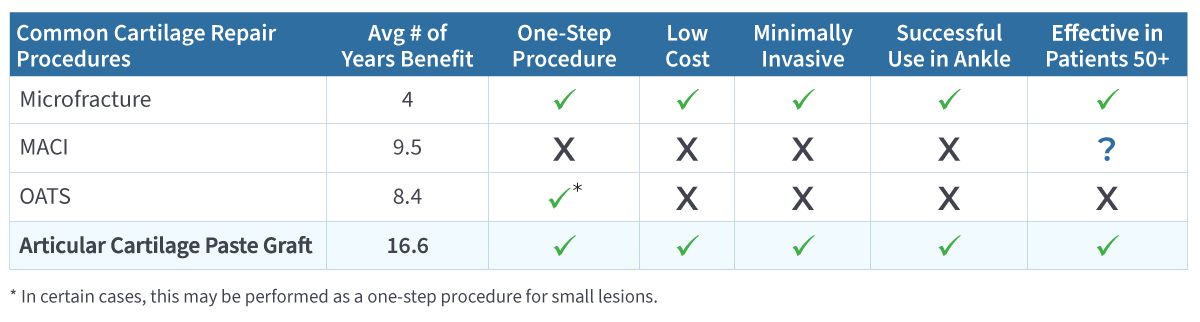
Damaged articular cartilage has a limited ability to heal on its own. Damage can lead to pain, swelling, and loss of motion. The articular cartilage paste graft (ArtCart) was developed in 1991 by Dr. Kevin R. Stone as a cost-effective, minimally invasive technique for cartilage repair indicated for both large and small cartilage lesions.

The technique uses a patient's own healthy cartilage and bone harvested from a neighboring site that is processed into a paste and impacted into the prepared cartilage defect area. Unlike other techniques, paste grafting is entirely arthroscopic, uses autologous tissue, and is performed in a single session.

Our research focuses on both clinical outcomes of ArtCart patients and the development of the new generation of ArtCart (ArtCart+), the augmented version of the paste graft designed to facilitate improved cartilage regeneration and global adoption for patients suffering from articular cartilage injury or osteoarthritis (OA).

Clinical Significance

Our long-term outcome data demonstrates that paste grafting provides sustained pain relief and functional improvement for patients with severe cartilage damage—a population often told their only option is joint replacement.

The 2016 study showing a median benefit time of 19.1 years following ArtCart represents one of the longest follow-ups in cartilage repair literature. Delaying partial or total knee replacement and brings a return to simple activity.

With ArtCart+, the addition of an adhesive agent and mesenchymal stromal cells (MSCs), there is augmented cartialge regeneration and improved graft attachment to surrounding tissue. ArtCart+ represent a single-step, globally accessible method of cartilage repair that will bring benefit to both veterinary patients and humans, enabling a robust return to movement.

Veterinary Applications

Our articular cartilage research extends to veterinary medicine, helping large animals who suffer from similar joint injuries recover using similar regenerative processes.

For Veterinary Clinics

Find out why you should implement ArtCart+ in your clinic.

Find Out Now

For Equine Owners

Find out how ArtCart+ can improve the quality of your equine patient's life.

Find Out Now

Current Research Projects

Active studies investigating new approaches to cartilage regeneration and paste graft optimization.

Patient Stories

Real patients share their journey through treatment and recovery.

BioKnee

BioKnee Program: Endurance Athlete

48-year-old endurance athlete discusses multiple meniscus surgeries and biologic knee replacement.

Joint Replacement

Robot-Assisted Partial Knee Replacement

Alaska ski instructor John Lyman discusses his experience with Mako robotic surgery.

Educational Videos

Surgical Technique

Articular Cartilage Paste Graft

Surgical demonstration of paste grafting for a medial femoral condyle lesion.

View Full Details
Surgical Technique

Robot-Assisted Partial Knee Replacement

Mako orthopedic technologies soft tissue, robotic-assisted partial knee replacement.

View Full Details

Patty B. one of the first patients to receive an ArtCart at The Stone Clinic

"ArtCart made a huge impact on my life. It allows me to do the things that make me happy and keep me going every day"

Published Studies

Showing 5 of 5 studies

Articular Cartilage Knee 1997

Surgical Technique for Articular Cartilage Transplantation to Full-Thickness Cartilage Defects in the Knee Joint

Kevin R. Stone, Ann Walgenbach

Research Question: How can full-thickness cartilage defects be repaired in a single procedure?

The mixture of articular cartilage and cancellous bone appears to provide a supportive matrix for cartilage formation. Pain relief is excellent if careful surgical technique and defined rehabilitation program is followed.

Key Finding: Original description of the paste graft surgical technique.

Operative Techniques in Orthopaedics View Publication
Articular Cartilage Knee 2006

Articular Cartilage Paste Grafting to Full-Thickness Articular Cartilage Knee Joint Lesions: A 2- to 12-Year Follow-up

Kevin R. Stone, Ann W. Walgenbach, Abhi Freyer, Thomas J. Turek, Donald P. Speer

Research Question: Does paste grafting provide lasting relief for severe cartilage damage?

Paste grafting is a low-cost, 1-stage arthroscopic treatment for patients with Outerbridge classification grade IV arthritic chondral lesions offering excellent, long-lasting pain relief.

Key Finding: 85.6% success rate; 63.6% of biopsies showed strong cartilage regeneration evidence.

Arthroscopy View Publication
Articular Cartilage Knee 2014

Osteochondral Grafting for Failed Knee Osteochondritis Dissecans Repairs

Kevin R. Stone, Johnathan R. Pelsis, John V. Crues III, Ann W. Walgenbach, Thomas J. Turek

Research Question: What treatment options exist for patients with osteochondritis dissecans (OCD) when prior repait procedures have failed?

Osteochondral grafting may be a viable treatment option for patients with knee OCD lesions after previous repair procedures have failed.

Key Finding: Patients with OCD treated with osteochondral graft were able to successfully regain knee function and experienced a reduction in pain.

Articular Cartilage Knee 2016

Articular Cartilage Paste Graft for Severe Osteochondral Lesions of the Knee: A 10- to 23-Year Follow-up Study

Kevin R. Stone, Johnathan R. Pelsis, Kellan Na, Ann W. Walgenbach, Thomas J. Turek

Research Question: Is articular cartilage paste grafting a durable, long-term treatment for severe cartilage loss in the knee?

The Articular Cartilage Paste Graft procedure can successfully treat severe cartilage damage, reduce pain, and improve function while also delaying the need for an artificial joint replacement.

Key Finding: Median benefit time of 19.1 years; 90% reported good-excellent pain relief; delayed arthroplasty to mean age 60.2 years.

Knee Surgery, Sports Traumatology, Arthroscopy View Publication
Articular Cartilage Knee 2020

Osteochondral Autograft Plugs versus Paste Graft: Ex Vivo Morselization Increases Chondral Matrix Production

Daniel Grande, Todd Goldstein, Thomas J. Turek, Susan Hennessy, Ann W. Walgenbach, Le Hanh Dung Do, David Greene, Kevin R. Stone

Research Question: Does morselizing cartilage damage cells or actually stimulate regeneration?

Morselizing cartilage for paste graft preparation does not appear to compromise early cell viability and may instead stimulate chondrocyte proliferation and cartilage matrix production.

Key Finding: Morselization increases chondrocyte proliferation 34-80%; contradicting long-held beliefs that impaction trauma leads to cell death.